
Far-Right AfD Victory Shakes Merz as Germany’s Political Firewall Faces New Pressure
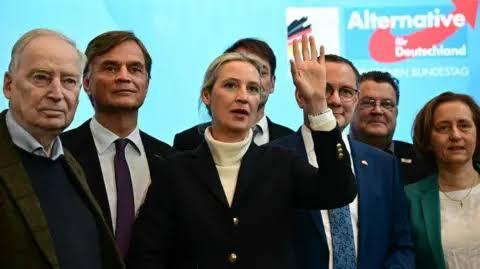
Germany’s far-right Alternative for Germany (AfD) has scored a major electoral breakthrough in Saxony-Anhalt, finishing first with nearly 44% of the vote and putting Chancellor Friedrich Merz’s conservatives under renewed pressure over their refusal to cooperate with the party.
Far-Right AfD Victory Shakes Merz as Germany’s Political Firewall Faces New Pressure
The political landscape in Germany has been jolted after the far-right Alternative for Germany (AfD) emerged as the strongest party in Sunday’s Saxony-Anhalt state election, delivering a result Chancellor Friedrich Merz acknowledged had shaken his Christian Democratic Union (CDU) “to its very foundations.”
The AfD secured nearly 44% of the vote, winning 39 of the 83 seats in the state legislature. Although that fell short of the 42 seats needed for an outright majority, the result gives the party a potentially influential position as politicians begin negotiations over the formation of the next state government.
The biggest question now is whether the AfD can persuade individual CDU lawmakers to support its attempt to govern. Such a development would represent a historic moment for Germany, where mainstream political parties have maintained a longstanding refusal to cooperate with the AfD.
That informal barrier, commonly described as the political “firewall,” is now facing one of its most serious tests.
Merz rejected any prospect of forming an alliance with the AfD and dismissed suggestions that he should step down following the poor performance of his party. He acknowledged the scale of the setback but said his government would continue with its broader reform programme.
“I will not deviate by even a millimetre from my fundamental conviction,” Merz said, defending his position on Russia and Germany’s continued support for Ukraine.
AfD seeks route into government
AfD national co-leader Tino Chrupalla called on CDU lawmakers in Saxony-Anhalt to help create what he described as a centre-right conservative majority. He argued that Germany’s established parties should abandon what he considers an outdated refusal to work with the AfD.
For now, however, the CDU has shown no indication that it intends to break with the firewall.
The populist left-wing Sahra Wagenknecht Alliance (BSW) is the only German party identified in the election coverage as being open to cooperation with the AfD. The two parties differ ideologically on many domestic issues but share positions on immigration, Germany’s support for Ukraine and relations with Russia.
The BSW and AfD have both criticised sanctions against Moscow and argued that closer economic ties with Russia could benefit German businesses.
Merz faces pressure beyond Saxony-Anhalt
The election result represents another challenge for Merz, whose approval ratings have fallen sharply as his coalition struggles to convince voters.
His government has been pursuing reforms alongside increased public spending, particularly in areas intended to strengthen Germany’s economy and security. But the AfD’s performance demonstrates the extent of voter frustration with established political parties, particularly in parts of eastern Germany.
Merz attempted to portray the political struggle as part of a wider confrontation over European security and Western democratic values. He argued that reducing support for Ukraine would not resolve the conflict with Russia and could instead worsen the security situation.
He also defended Germany’s decision to take on hundreds of billions of euros in additional borrowing for defence, saying the future unity of NATO remained at stake.
“Giving up is not an option for me,” Merz said.
AfD eyes bigger gains
The Saxony-Anhalt result has also strengthened the AfD’s ambitions at the national level.
National co-leader Alice Weidel described the election as a milestone and said the party would aim to secure at least 40% of the vote at Germany’s next federal election, scheduled for 2029.
The party’s support was particularly strong among men, with 50% backing the AfD compared with 39% among women, according to the voter breakdown cited in the election coverage. Support was also stronger among voters with lower levels of economic security and education.
The AfD has been classified as right-wing extremist by the domestic intelligence service in Saxony-Anhalt. The party rejects such characterisations and says accusations of extremism are politically motivated.
During the campaign, AfD candidates sought to capitalise on frustration with mainstream parties, promising tougher immigration policies, safer streets and a stronger emphasis on national identity. In parts of eastern Germany, nostalgia for the former communist era has also contributed to the political debate.
European concern grows
The AfD victory has attracted attention beyond Germany. French officials warned that the result reflected a broader populist challenge spreading across Europe, while Poland also expressed concern about the direction of German politics.
French Finance Minister Roland Lescure called the result a “very, very worrying signal” and said European countries faced a significant challenge from the growing populist wave.
The election therefore carries implications beyond one eastern German state. For Merz and the CDU, the immediate challenge is to prevent further losses while maintaining the political barrier against the AfD.
For the AfD, meanwhile, Saxony-Anhalt provides a powerful argument that it is moving closer to becoming a force capable of competing for government — even if it has not yet secured the parliamentary majority required to rule alone.
Tags
More Stories
West Bengal ‘Practically Bankrupt’? Adhikari Says Recovery Will Take at Least 1 Year; Here’s What the Numbers Show
7 Sept 2026

Kangana Ranaut Rebukes Officials Over Slow MPLADS Fund Use, Calls Delays a ‘Bloody Joke’
6 Sept 2026
Centre Constitutes 31-Member JPC on FCRA Amendment Bill 2026; BJP's Sanjay Jaiswal Named Chairperson
3 Sept 2026

Telangana BJP Chief N Ramchander Rao Taken Into Preventive Custody Ahead of Nalgonda Visit
1 Sept 2026