
From ‘New America’ to Tariff Threats: How Trump’s Pressure Campaign Is Reshaping Global Alliances
US President Donald Trump’s latest push to rename New Mexico, combined with tariff threats, military warnings and pressure on allies, is adding to growing concerns about Washington’s relations with Canada, Mexico and Europe. At the same time, countries including India, China, Russia and Brazil are exploring stronger ties beyond the US.
From ‘New America’ to Tariff Threats: How Trump’s Pressure Campaign Is Reshaping Global Alliances
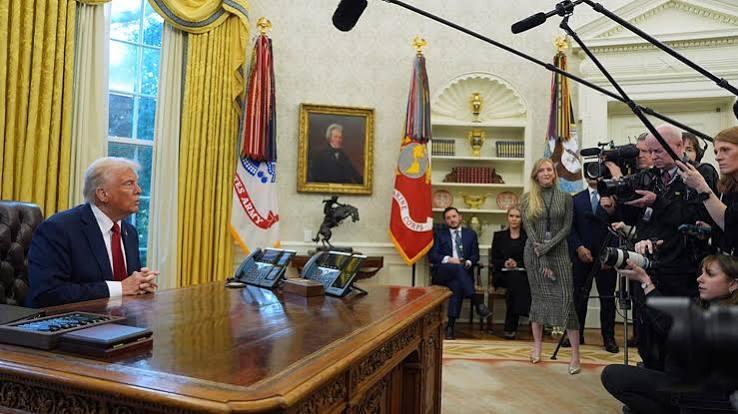
US President Donald Trump’s increasingly confrontational approach to trade, security and foreign policy is putting pressure on long-standing alliances, while encouraging several countries to deepen relationships outside Washington.
The latest controversy erupted after Trump posted a map suggesting that the US state of New Mexico should be renamed “New America.” The post came during a burst of activity on Truth Social, where Trump shared dozens of messages in less than an hour.
The proposal immediately drew criticism from lawmakers in New Mexico, who argued that the state's name represents generations of history and culture.
But the naming controversy is only one part of a much broader pattern.
Trump has already pushed for changes involving geographic names, threatened higher tariffs on major trading partners and discussed stronger action against drug cartels. His administration's approach has also intensified debate in Europe over whether the continent needs greater strategic independence from the United States.
At the same time, Canada is strengthening economic links with Europe, while countries across Asia and Latin America are looking for ways to diversify their international partnerships.
‘New America’ proposal triggers backlash
Trump's proposed renaming of New Mexico followed earlier moves involving the Gulf of Mexico and Lake Ontario.
Democratic lawmakers from New Mexico quickly rejected the idea.
Senator Martin Heinrich said he would continue using the state's existing name, while Representative Melanie Stansbury argued that New Mexico's identity and history could not simply be changed by presidential declaration.
Representative Gabe Vasquez similarly pushed back against the proposal, saying the state's name and heritage belonged to its residents.
The response demonstrated how Trump's naming campaigns can quickly become political flashpoints beyond their symbolic significance.
The dispute also comes against a broader backdrop of tensions with Mexico and Canada.
Trump escalates pressure on Mexico
The more consequential dispute involves trade and security.
During an Oval Office event on September 4, Trump raised the possibility of cutting off trade with Mexico, pointing to what he described as a large US trade deficit.
He also suggested that restricting trade with Canada could save the United States tens of billions of dollars.
The comments come while negotiations surrounding the US-Mexico-Canada Agreement (USMCA) continue. Trump's tariff threats therefore carry both economic and negotiating implications.
The US president has also connected his tariff policies with pressure for lower interest rates, adding another dimension to his administration's economic strategy.
Military threats raise the stakes
Trade pressure is not the only source of concern.
The US has conducted operations against suspected drug-trafficking boats in the Caribbean and Pacific. Trump has claimed that the campaign has sharply reduced the amount of drugs entering the United States by sea and indicated that the next phase could involve operations against cartels on land.
The comments have raised particular concern because any US military action inside Mexican territory without Mexico City's consent would represent a major escalation involving a close US ally and one of America's largest trading partners.
Mexican President Claudia Sheinbaum has previously made clear that US forces would not be permitted to conduct military operations on Mexican soil without Mexican approval.
Trump has made similar suggestions in the past, meaning the latest comments are being viewed within a longer-running dispute over the US approach to Mexican cartels.
Canada says its relationship with Washington has changed
Canada provides perhaps the clearest example of the impact Trump's policies are having on a traditional US ally.
Trump has repeatedly floated the idea of Canada becoming part of the United States and has even described the possibility of Canada becoming the country's 51st state.
Canadian Prime Minister Mark Carney, however, has taken a sharply different position.
Following disputes over tariffs and trade, Carney said Canada needed to fundamentally rethink its economy and argued that the country's traditional relationship with the United States had effectively changed.
Ottawa has subsequently increased its diplomatic and economic engagement with Europe and China while searching for additional markets.
Canada and the EU move closer
The deterioration in US-Canada relations has coincided with stronger Canadian engagement with the European Union.
Trade negotiations between Washington and Ottawa broke down in late August, after which the United States imposed a 50% levy on $20 billion worth of Canadian goods.
Canada responded with plans for retaliatory measures covering a range of American products, including steel, dairy products, electronics, appliances, agricultural equipment and pulp and paper.
Canada also raised duties on US steel and aluminium to 50%.
Meanwhile, discussions between Ottawa and Brussels have accelerated.
Canada and the EU are working towards closer cooperation in areas including digital trade, data, cybersecurity and artificial intelligence. Canada is also considering deeper participation in the Comprehensive and Progressive Agreement for Trans-Pacific Partnership, or CPTPP, a major Pacific trade arrangement that does not include the United States.
The existing Canada-EU trade relationship has also expanded significantly since the implementation of CETA.
For Ottawa, the strategy represents an attempt to reduce excessive dependence on the US market.
Europe debates strategic autonomy
Trump's approach has also strengthened calls in Europe for greater strategic independence.
European leaders have publicly challenged Washington over tariff threats and disputes involving Greenland while simultaneously debating how much the continent should rely on the United States for defence and security.
European Commission President Ursula von der Leyen has warned against undermining long-standing alliances through unilateral economic pressure.
French President Emmanuel Macron has been among the most vocal supporters of greater European strategic autonomy. He has also raised the possibility of extending France's nuclear protection to other European countries.
At a March 2026 summit, European leaders described joint defence efforts as a major turning point, while some governments argued that Europe must become more capable of protecting its own interests.
However, the push for independence is not without obstacles.
European countries disagree over the future direction of defence policy, while political leaders supporting strategic autonomy face domestic political challenges.
India, China and Russia signal closer cooperation
Asia is also becoming an important part of this shifting diplomatic landscape.
At the Shanghai Cooperation Organisation summit in Tianjin, the leaders of China, Russia and India appeared together and spoke about strengthening cooperation.
Prime Minister Narendra Modi highlighted improving momentum in India-China relations and reiterated the importance of India's relationship with Russia.
The development comes amid trade tensions between Washington and both India and China.
Trump has imposed tariffs on both countries and has separately targeted India over its purchases of Russian oil.
While the three countries continue to have significant disagreements and competing strategic interests, their increasing engagement illustrates how countries may seek alternative partnerships when relations with Washington become more difficult.
Brazil also looks beyond the US
Latin America is showing similar signs of diversification.
Brazil has faced a substantial US tariff on its exports, increasing pressure on the country to develop alternative markets.
Brasilia has continued strengthening relationships with Europe, the Gulf region and India while maintaining its important economic relationship with China.
Brazil's involvement in Mercosur and its trade arrangements with other regions could provide additional options as businesses and governments attempt to reduce exposure to US trade policy.
Not all US alliances are breaking down
Despite the growing tensions, Trump's foreign policy has not completely separated Washington from its traditional partners.
The US, Britain and European countries continue to cooperate on several major international issues.
Western governments have coordinated sanctions against Iran and Russian energy interests, while Washington and European partners have also worked together on changes to sanctions affecting Syria.
This suggests that Trump's pressure campaign has produced different outcomes depending on the issue and the country involved.
Economic and security interests can still push countries towards cooperation with Washington even while political disagreements deepen.
Is Trump deliberately reshaping the global order?
There are competing explanations for the changes taking place.
One interpretation is that Trump's tariff threats, security demands and diplomatic pressure are deliberately being used to force other countries to make concessions.
Another view is that the current realignment is partly an unintended consequence of applying pressure simultaneously to numerous partners.
When countries face uncertainty over tariffs, trade restrictions, security commitments and visa policies, they have greater incentives to build alternative relationships.
That does not necessarily mean these countries are forming a unified anti-US bloc.
China, India and Russia, for example, have their own strategic disagreements. Canada and Europe may cooperate more closely without abandoning their relationships with the United States entirely.
A world of more diversified partnerships
The emerging picture is therefore more complicated than a simple shift away from Washington.
Trump's policies are encouraging countries to diversify their economic and diplomatic options, but that does not automatically translate into permanent alliances against the US.
Canada is expanding its European and Pacific connections. Europe is debating strategic autonomy. India, China and Russia are increasing engagement despite their differences, while Brazil is seeking additional trading partners.
The common thread is that governments appear increasingly interested in reducing their vulnerability to sudden changes in US policy.
Whether this ultimately produces a lasting restructuring of the global economic and security system remains uncertain.
For now, however, Trump's combination of tariffs, diplomatic pressure, territorial rhetoric and security threats is clearly forcing allies and rivals alike to reconsider how heavily they depend on Washington.
More Stories
Peskov Says 90% of Russia-BRICS Transactions Use National Currencies
8 Sept 2026

US Leads Global Finance Jobs as London and Hong Kong Hold Key Niches
8 Sept 2026

Toronto Homeowners Face Heavy Losses as Property Prices Reverse
8 Sept 2026
Falkland Islands dispute explained: Why the UK and Argentina are still fighting over the islands
8 Sept 2026