
Putin, Xi Jinping and Middle East Tensions Put India’s BRICS Summit in Focus
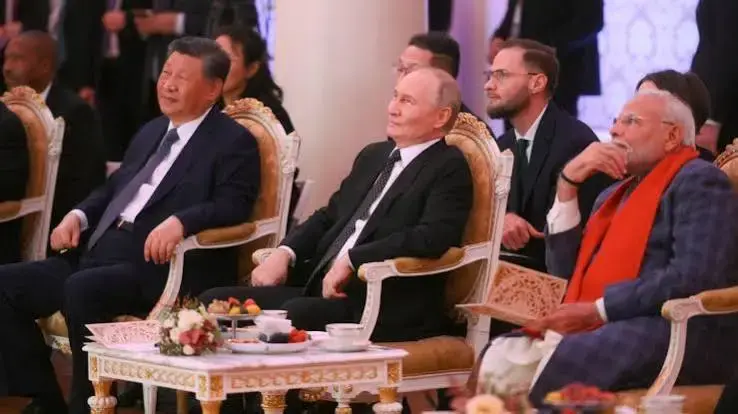
India is preparing to host a high-stakes BRICS summit on September 12 and 13, with Russian President Vladimir Putin, Chinese President Xi Jinping and Iranian President Masoud Pezeshkian among the key leaders expected to attend. The Middle East conflict is likely to complicate negotiations as New Delhi seeks consensus among an increasingly diverse BRICS bloc.
Putin, Xi Jinping and Middle East Tensions Put India’s BRICS Summit in Focus
India is set to host one of the most diplomatically challenging BRICS summits in recent years, with leaders and senior representatives from Asia, Africa, the Middle East and Latin America expected to gather in New Delhi on September 12 and 13.
Russian President Vladimir Putin and Chinese President Xi Jinping are among the most closely watched participants, while Iranian President Masoud Pezeshkian is also expected to attend.
The expanded BRICS grouping now brings together countries with widely different geopolitical interests, making India's role as host particularly important.
Middle East Conflict Could Dominate Talks
While the official agenda is expected to centre on trade, development financing and reform of global institutions, the ongoing conflict in the Middle East is likely to feature prominently behind closed doors.
Iran is expected to seek language in the summit declaration reflecting its position on the recent conflict, military strikes and sanctions.
Reaching agreement could prove difficult because BRICS decisions are based on consensus, meaning disagreements over sensitive geopolitical issues can complicate the final declaration.
Diplomats involved in the preparations are therefore closely watching negotiations over references to West Asia and the broader Middle East crisis.
India Faces a Delicate Balancing Act
For New Delhi, the summit presents a major diplomatic challenge.
India has strengthened its strategic relationship with Israel, while simultaneously maintaining long-standing economic, diplomatic and energy ties with Iran.
The Gulf region is also critically important to India because millions of Indians live and work there, while the region remains central to India's energy supplies and trade routes.
Any major escalation in the Middle East could therefore affect oil supplies, shipping costs, trade and India's wider economic interests.
The potential disruption of shipping routes around the Red Sea and the wider region could also have consequences for global commerce and countries dependent on the Suez Canal.
Putin and Xi Add Another Diplomatic Dimension
The expected presence of Putin and Xi will place India's relationships with Russia and China under renewed international scrutiny.
India continues to maintain significant defence and energy ties with Russia, despite pressure from Western countries over Moscow's international policies.
At the same time, India-China relations have seen efforts toward stabilisation following years of military tensions along the Line of Actual Control. Despite those developments, strategic competition between New Delhi and Beijing remains.
With both leaders potentially in Delhi at the same time, India's ability to maintain diplomatic balance will be closely watched.
BRICS Expansion Makes Consensus Harder
The expanded BRICS grouping has brought together countries with increasingly diverse foreign-policy priorities.
Indonesia, with President Prabowo Subianto expected to make a prominent appearance, adds another major Southeast Asian voice to the grouping.
African representation includes countries such as Egypt, Ethiopia and South Africa, while other nations including Nigeria, Kazakhstan, Uzbekistan, Malaysia, Thailand and Cuba are expected to participate in different capacities.
The wider membership means the bloc contains countries with sometimes competing strategic interests.
Russia and China have deepened their strategic partnership, while Iran remains sharply opposed to much of the US-led international security structure.
At the same time, Gulf countries such as Saudi Arabia and the UAE maintain important security relationships with Washington while expanding their economic engagement with BRICS.
Managing these competing positions will be one of India's biggest challenges as summit host.
What India Wants From the Summit
New Delhi is expected to push the summit toward issues that can generate broader agreement, including trade, technology, development, investment and reform of international institutions.
However, negotiations over the final declaration could become particularly difficult if disagreements over the Middle East dominate the discussions.
Any sudden development in the region before or during the summit could also change the diplomatic calculations of participating countries.
A Major Diplomatic Test for New Delhi
India's immediate objective will be to bring the diverse group of leaders together and guide negotiations toward a joint declaration acceptable to all members.
The most difficult negotiations may ultimately centre on only a few paragraphs dealing with the Middle East.
If New Delhi succeeds in maintaining consensus while securing progress on economic cooperation, technology, development financing and global institutional reform, the summit could represent a significant diplomatic achievement for India.
The September 12-13 BRICS summit will therefore be about much more than hosting Putin, Xi and other world leaders. For India, the bigger challenge will be keeping an increasingly divided group united around a common agenda.
More Stories
Peskov Says 90% of Russia-BRICS Transactions Use National Currencies
8 Sept 2026

US Leads Global Finance Jobs as London and Hong Kong Hold Key Niches
8 Sept 2026
Toronto Homeowners Face Heavy Losses as Property Prices Reverse
8 Sept 2026
Falkland Islands dispute explained: Why the UK and Argentina are still fighting over the islands
8 Sept 2026